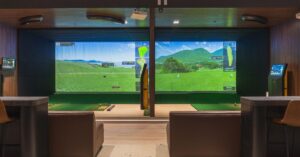
The golf industry is undergoing a measurable shift. As consumer preferences evolve toward technology-driven, experience-focused entertainment, indoor golf franchises, particularly golf simulator franchises, are increasingly viewed as one of the most attractive opportunities within the broader category of golf businesses for sale.
Traditional golf companies have long faced structural challenges, including weather dependency, high land costs, and seasonal revenue fluctuations. In contrast, indoor golf simulators offer a controlled, year-round environment that appeals to both dedicated golfers and a growing segment of casual, experience-driven consumers. This dynamic has positioned simulator-based concepts as a modern alternative within the golf entertainment franchise space.
Market Demand for Simulator-Based Golf Entertainment
Industry data supports this shift. According to the National Golf Foundation, off-course golf participation, including simulator golf, has grown significantly over the past decade, often outpacing traditional on-course participation. This trend reflects changing consumer expectations around flexibility, social engagement, and technology-enabled experiences.
As a result, investors evaluating a golf business for sale are increasingly prioritizing concepts that combine sport, hospitality, and entertainment. A social golf venue built around simulators can accommodate league play, corporate events, casual social gatherings, and skill development, often within the same operating day. This versatility improves space utilization and revenue efficiency, reinforcing the model’s reputation as a profitable golf business.
Franchise Structure and Operational Advantages
Operational structure plays a significant role in long-term success. Independent golf entertainment businesses for sale may appear attractive initially, but they frequently lack standardized systems, centralized marketing, and established vendor relationships. A turnkey golf business operating under a franchise model reduces operational uncertainty by providing proven processes, brand recognition, and ongoing support.
For investors seeking scalability, a franchise golf business offers a clear advantage. Standardized training, technology integration, and marketing systems make it easier to expand beyond a single location, supporting the development of a scalable golf franchise rather than a standalone operation.
Comparison to Other Sports Entertainment Franchises
Within the broader sports entertainment franchise landscape, simulator golf holds a distinct position. Golf consistently attracts higher-income demographics, corporate clients, and repeat customers who participate weekly rather than seasonally. This behavior drives strong food and beverage sales, private event bookings, and long-term customer engagement.
Additionally, technology-driven golf venues align closely with broader experience economy trends, allowing golf simulator franchises to compete effectively with premium leisure and hospitality concepts. As a result, many investors searching for golf companies for sale are narrowing their focus to indoor, simulator-based models.
Conclusion
The rise of simulator golf reflects broader changes in how consumers engage with sports and entertainment. For investors evaluating a golf entertainment business for sale, indoor golf franchises represent a modern, resilient, and scalable investment opportunity.
As demand for immersive, social, and technology-enabled experiences continues to grow, the golf simulator franchise model is positioned not as a short-term trend, but as a defining segment of the future golf industry.